
What the Scarlet Firethorn Taught Me About Boundaries with Love
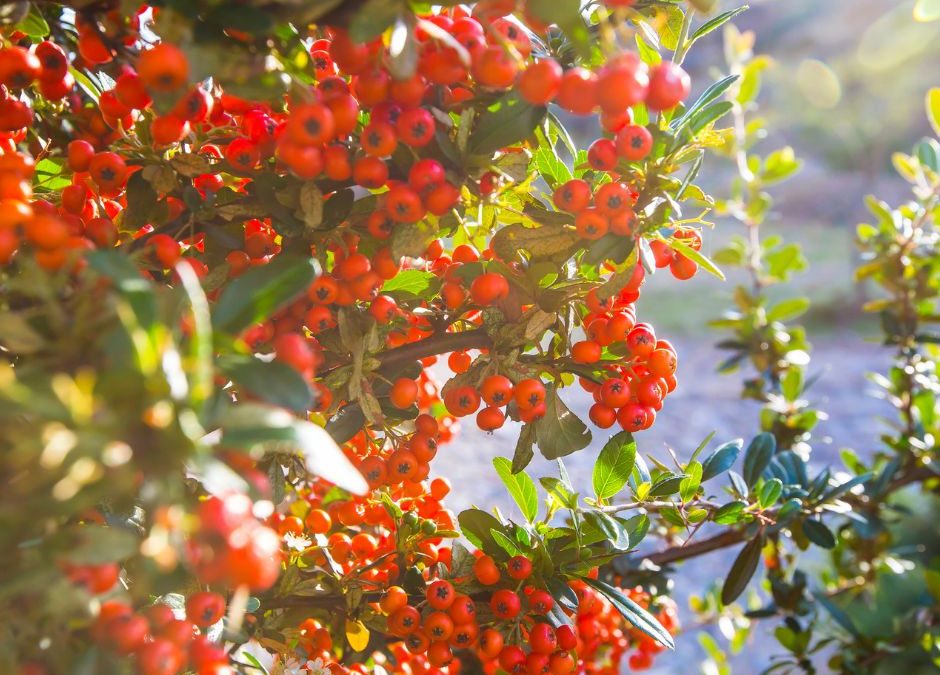
Last weekend, as I was walking through the park with my dog Herki, I discovered the most beautiful Scarlet Firethorn. Its branches were covered in clusters of brilliant red berries, glowing against the deep green leaves. And, as so often happens, I became very curious. It was one of those moments when something in nature catches my full attention and just invites me to stop.
The Scarlet Firethorn, or Pyracantha coccinea, is an evergreen shrub with very sharp thorns. Its berries provide food for the birds, while its dense branches offer them shelter when needed. There was something about this combination that just stayed with me. The berries. The shelter. The thorns.
Here was a plant that offers nourishment and protection to the birds, while protecting itself. And it got me thinking…Can we be kind, loving and generous without abandoning ourselves in the process?
When Being Kind Means Saying Yes
I wonder how many of us grew up believing that being a good person meant being helpful, friendly and considerate of others. We learned to…
- avoid conflict.
- keep the peace.
- put other people’s needs before our own.
- say yes even when something within us was loudly saying no.
Over time, these ways of responding became so familiar to us that we just stopped noticing them.
- Someone asks us for a favour. We immediately agree.
- Someone is disappointed. We feel responsible for making things better.
- Someone needs support. We rearrange our own plans, even when we’re already exhausted.
Sometimes we do these things because we genuinely want to. Because we care. Because helping someone else brings us joy. But there are also times when something else is bubbling beneath our kindness.
We’re afraid of disappointing someone, or we worry that they’ll think we’re selfish. Maybe we believe that saying no will make us less lovable, or we’ve simply become so used to considering everyone else’s feelings that we’ve forgotten to include our own. And that’s where I think an important question begins. Am I choosing this kindness freely, or am I afraid of what might happen if I don’t?
“When we fail to set boundaries and hold people accountable, we feel used and mistreated.” ― Brene Brown
The Quiet Ways We Leave Ourselves Behind
Self-abandonment doesn’t always look dramatic, sometimes it’s made up of very small moments.
- We say we’re fine when we’re not.
- We agree to something we don’t have the energy for.
- We ignore the discomfort in our body because we don’t want to inconvenience someone.
- We apologise for having needs.
- We remain silent when something matters deeply to us.
We tell ourselves that it doesn’t matter. That we’re being too sensitive. That other people have more important problems than we do and each moment seems insignificant on its own.
Over time, we begin to notice that we’re becoming less and less connected with ourselves. We know what everyone else wants. We know what everyone else expects. We can sense when someone is unhappy. We can anticipate what makes things easier for them. Yet when someone asks us what we want, we struggle to answer.
We’ve become so skilled at listening to others that we’ve totally forgotten how to listen to ourselves. This doesn’t mean we’re weak or that there’s something wrong with us. Often these patterns developed because they helped us to navigate difficult relationships or circumstances.
Maybe keeping the peace once felt safer than expressing ourselves. Maybe being helpful brought approval or belonging. We learned very early on that other people’s needs came first. And if that’s been our experience, learning to respond differently takes time.
We don’t have to criticise ourselves for the ways we learned to protect our relationships. We can begin by noticing. Noticing whether those ways are still protecting our relationship with ourselves.
Click here and learn more about The REmembrance Circle. Come and join us!
What the Firethorn Reminded Me
I keep coming back to that beautiful Firethorn. Its thorns don’t make its berries less nourishing. Its protective branches don’t make it less beautiful, and the fact that it has natural defences doesn’t prevent it from offering shelter. Of course, plants don’t make conscious decisions about boundaries in the way we do, but nature offers us wonderful images through which to explore our own lives.
The Firethorn invites us to question an old belief…that being loving means always being available. That being generous means giving without limits. That being compassionate means never disappointing anyone.
Kindness doesn’t have to mean any of these things. We can care deeply about someone and still need time for ourselves. We can understand another person’s disappointment without taking responsibility for removing it. We can be generous while recognising that our energy isn’t unlimited. We can offer support without taking over someone else’s responsibilities. And we can say no to a request without rejecting the person who made it. Our boundaries don’t cancel out our kindness. They help us to remain present within it.
“You don’t need to become someone new. You are here to REmember who you are.” – Fiona Elizabeth
Why Saying No Can Feel So Difficult
I think one of the most challenging parts of setting boundaries is what happens inside of us afterwards. We might finally find the courage to say…I’m sorry, I can’t do that today…and then almost immediately, the guilt arrives.
Was I selfish?
Should I have explained more?
What if they’re upset with me?
Maybe I should have just done it anyway.
Sometimes we begin negotiating against our own boundaries before the other person has even responded. This is where self-compassion is especially important, because setting a boundary doesn’t necessarily mean we’ll feel comfortable with it. We may…
- feel anxious.
- feel guilty.
- be tempted to go back and change our answer.
But those feelings don’t automatically mean we’ve done something wrong. They simply mean we’re practising something unfamiliar…something that challenges an old pattern. And rather than immediately trying to make the discomfort disappear, we can pause and listen.
What am I afraid will happen?
What do I need right now?
Am I allowed to have that need, even if someone else doesn’t like it?
We don’t have to force ourselves to become fearless. We can acknowledge our fear and still consider what is right for us. Sometimes staying with ourselves means allowing another person to have their feelings without us abandoning our own.
“Walls keep everybody out. Boundaries teach people where the door is.” – Mark Groves
Boundaries with Love
I love the expression Boundaries with Love…because it reminds me that a boundary doesn’t have to be an act of anger or rejection. It can also be an expression of care. Caring for…
- our time.
- our energy.
- our wellbeing.
- our values.
- the relationships we want to nurture.
Of course, boundaries aren’t always easy. Sometimes they need to be firm. Sometimes they need to be repeated. Sometimes we may need to recognise that a relationship isn’t respecting our limits. Yet in everyday life, a boundary can be surprisingly simple.
I’d love to help, but I can’t today.
I need some time to think before I answer.
I care about what you’re going through, but I don’t have the capacity to talk about it right now.
I’m not comfortable with that.
I need some quiet time for me this evening.
And sometimes a boundary isn’t something we say out loud. Maybe it’s choosing not to answer a message immediately or taking a break when we feel tired. Maybe it’s allowing ourselves to enjoy something without feeling guilty or noticing the urge to explain and justify every decision we make. It’s gently reminding ourselves that our needs are allowed to exist.
Not every boundary requires a long explanation and not every boundary will be welcomed. Yet we can begin to recognise that another person’s disappointment doesn’t automatically mean we’ve been unkind or selfish. We can be considerate of others without making their comfort the measure of our worth.
Can I Stay in Relationship with Myself?
There’s one question that has become increasingly important in my life and work. Can I stay in relationship with myself while life is happening?
I think this question becomes particularly meaningful when we’re in relationship with other people. It’s so much easier to remain connected with ourselves when nobody is asking anything of us. When we’re alone, when everything is peaceful, when there are no competing needs or expectations.
But…what happens when someone wants something we don’t want to give? When we disagree or when someone is disappointed? When we feel under pressure to say yes? Can we still…
- hear ourselves?
- notice what we’re feeling?
- recognise our needs without immediately dismissing them?
- remain on our own side while still treating the other person with care?
This is one of the deeper invitations of boundaries. Not simply learning to say no but learning to stay present with ourselves while we’re deciding what to do. Noticing that familiar pull towards pleasing, fixing or rescuing. Pausing before automatically responding and asking…
What is true for me in this moment?
What am I genuinely able and willing to offer?
Can I make this choice without leaving myself out of it?
Maybe we won’t always get it right. Maybe we’ll still say yes when we wanted to say no. Maybe we’ll recognise a boundary only after we’ve crossed it. But it doesn’t mean we’ve failed. Every moment of awareness gives us another opportunity to choose. And if we lose connection with ourselves, we can always REturn.
“Self-compassion is simply giving the same kindness to ourselves that we would give to others.”
~ Christopher Germer
Kindness That Includes Us
We often speak about self-compassion as though it’s something completely separate from the way we live with others, or it’s just something that we practise in those quiet moments. Through…
- Meditation.
- Journaling.
- Affirmations.
- Words of encouragement.
All of these are beautiful, meaningful practices…but self-compassion also lives in our everyday choices. In the moment that we recognise we’re exhausted and decide to rest. In the moment we acknowledge that something doesn’t feel right. In the moment we stop apologising for needing space. In the moment we speak honestly rather than automatically agreeing. And especially, in the moment we feel guilty for choosing ourselves but we choose anyway not to attack ourselves for having that feeling.
Being compassionate towards ourselves doesn’t mean we’ll never experience discomfort. It means we’re learning to accompany ourselves through it anyway.
Self-compassion isn’t only how we comfort ourselves afterwards. It’s also how we learn not to leave ourselves behind in the first place. And perhaps that’s a different way of understanding kindness…not something that just flows outwards but something that includes us, too.
“At the most basic level, self-compassion simply requires being a good friend to ourselves.”
― Kristin Neff
🌿 A Moment of REmembrance — The Firethorn Reflection
If you have a few quiet minutes today, just gently sit with these questions or add them to your journal. There’s no need to answer them all, just notice which one speaks to you.
🌹 Where am I giving freely?
Think of a relationship or a situation where you offer your time, your energy or your support. Does your giving feel like a genuine choice or do you sometimes feel afraid of what might happen if you say no?
🌿 Where might I need a little protection?
Is there an area of your life where you’ve been ignoring your own needs? Perhaps you need more rest, more space, more time to make decisions or permission to say what you really feel.
💞 What would a boundary with love look like?
If you could honour both your compassion for others and your compassion for yourself, what might you choose differently? Maybe it’s something very small. A pause before answering or a gentle no. A request for help or simply acknowledging to yourself…My needs matter too.
You don’t have to change everything today and you don’t have to become someone who never struggles with boundaries. You can begin by listening, by noticing and allowing yourself a place in the relationships that you’re part of.
The Beauty of Being Both
I think that the beautiful Scarlet Firethorn will stay with me for some time. Those brilliant red berries, the deep green leaves, the sharp thorns, the shelter it offers amongst its branches. And the reminder that protection and generosity don’t have to be opposites.
We don’t have to choose between being loving and being true to ourselves, between caring for others and caring for our own wellbeing or between having an open heart and recognising our limits. We can learn to hold both. We can…
- be gentle without being endlessly available.
- be compassionate without taking responsibility for everyone else’s feelings.
- be generous without giving ourselves away.
- remain loving without abandoning ourselves.
Boundaries aren’t walls that keep love out. They are ways of caring for the space in which love can grow. And perhaps, just like the beautiful Scarlet Firethorn, we can learn to be both…Soft-hearted and well-boundaried. 🌿❤️🌳💞
You might also be interested in reading these blogs…
Limited Self-Compassion: Being Our Harshest Critic
Staying With Yourself Instead of Trying to Fix How You Feel
BIG Love


Recent Comments